One balcony panel, tracked
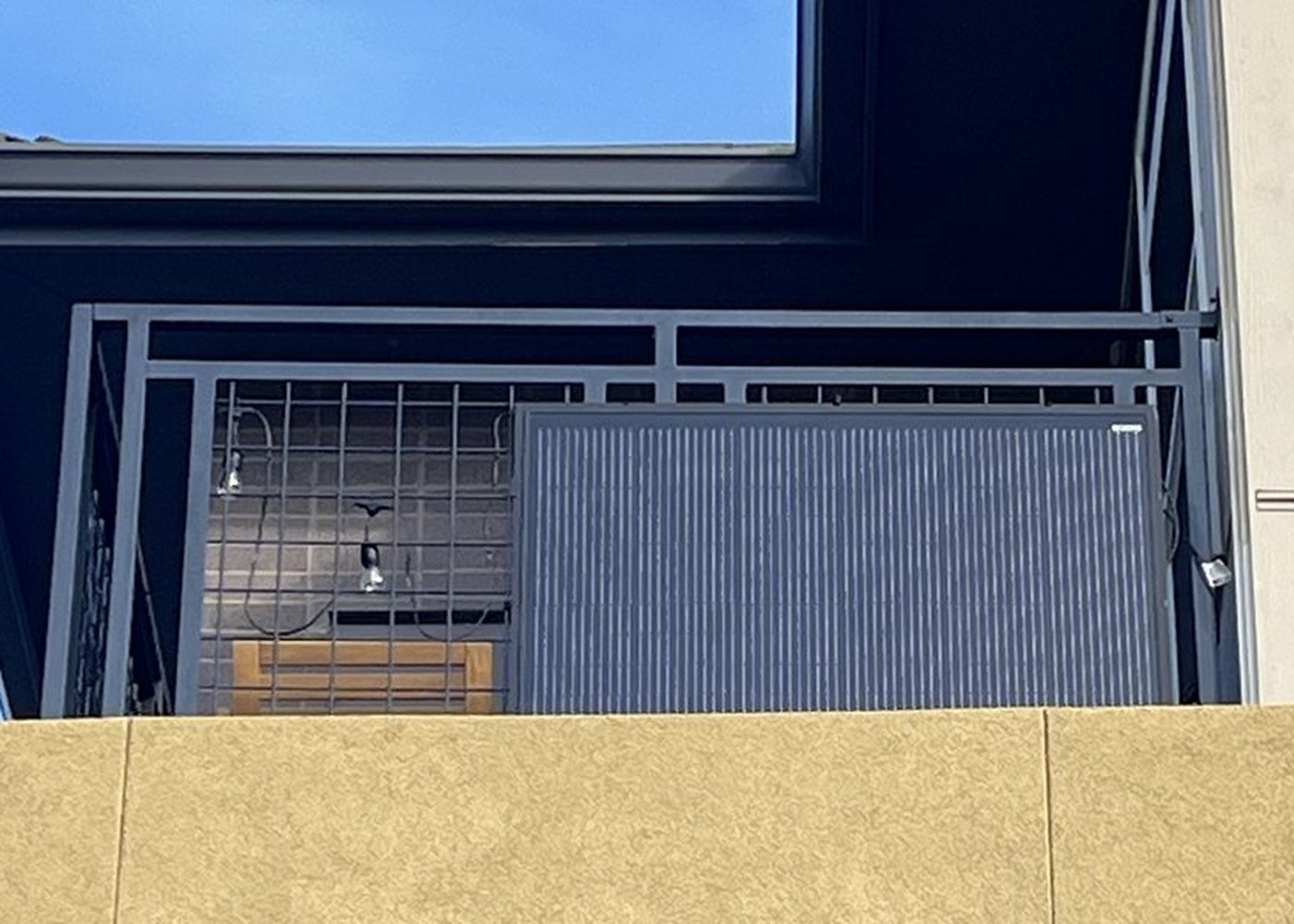
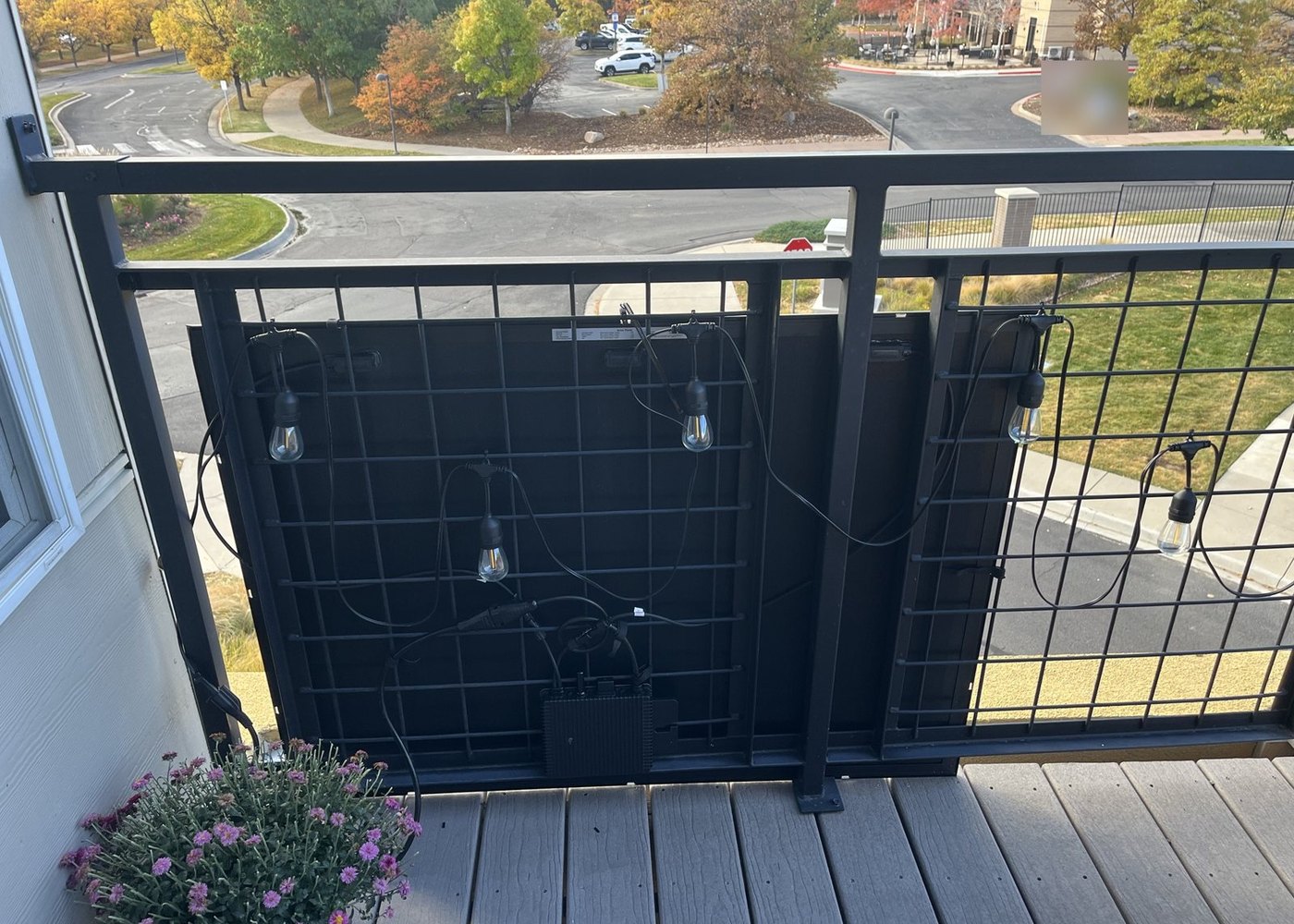
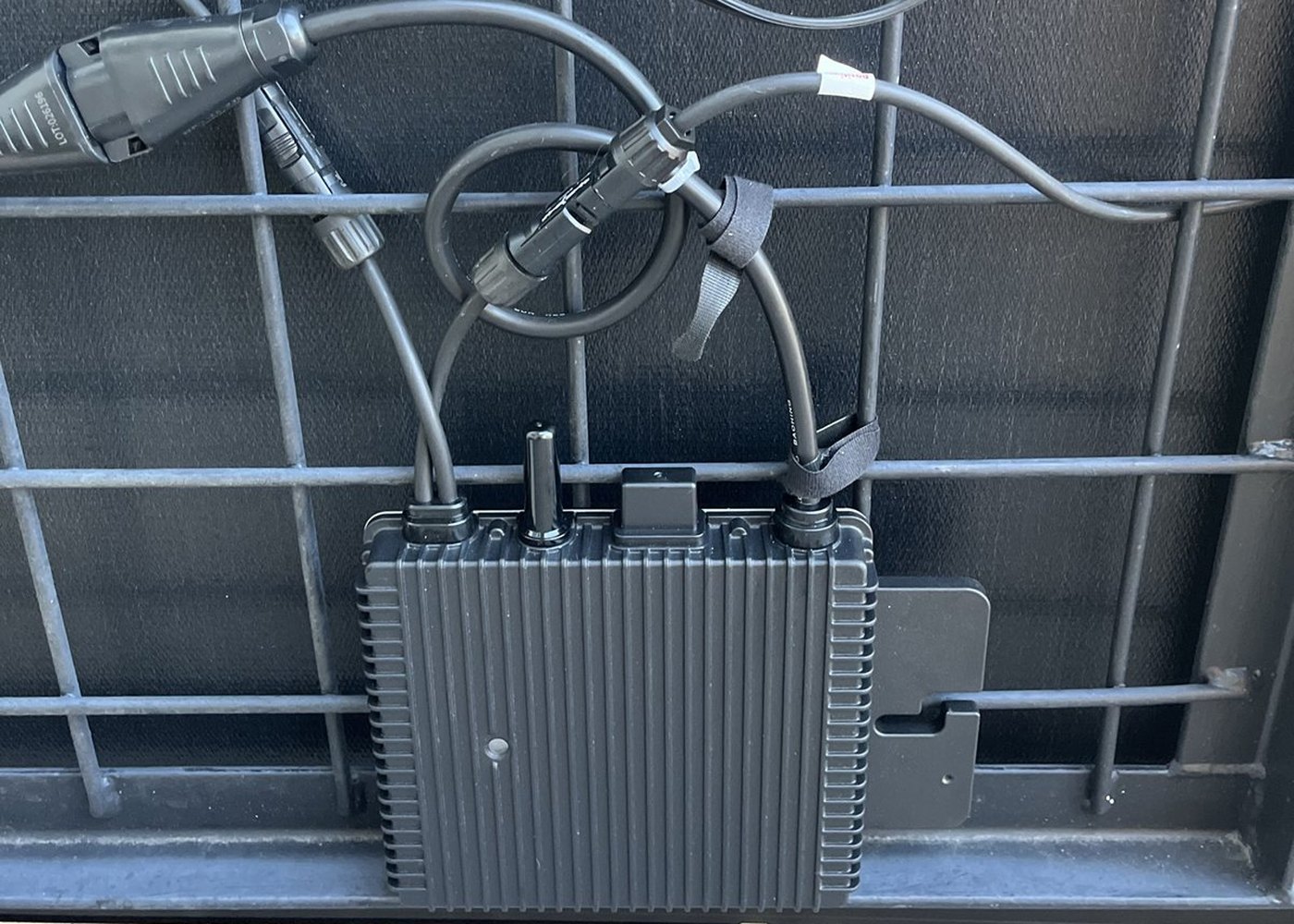
This case study follows a single 180 W plug-in solar kit on a south-facing apartment balcony in Denver, Colorado. The kit was bought from Bright Saver after becoming a member; its Hoymiles inverter carries a UL 3700 subassembly certification (Bright Saver notes whole-kit UL 3700 certification is still pending).
The goal is to test the Designer’s estimates against reality. Each day, sunlight measured at NLR’s solar research laboratory in Golden, Colorado, about 15–20 miles away, is compared with what the panel’s inverter records. The sun hours are turned into an estimate of production and then compared with the actual result. Over time this will show how accurate the Designer is, or where there’s room to improve.
Fully online since October 28, 2026. One of the first plug-in solar systems in the country, and compliant with Colorado’s plug-in solar law (HB 26-1007).
- 360 VA, under the law’s 391 W small-device tier: no rewiring or installer requirements
- Listed inverter (UL 3700 subassembly, CSA 80310016) with built-in outage shutoff
- One device, plugged into a standard outdoor GFCI outlet
The setup
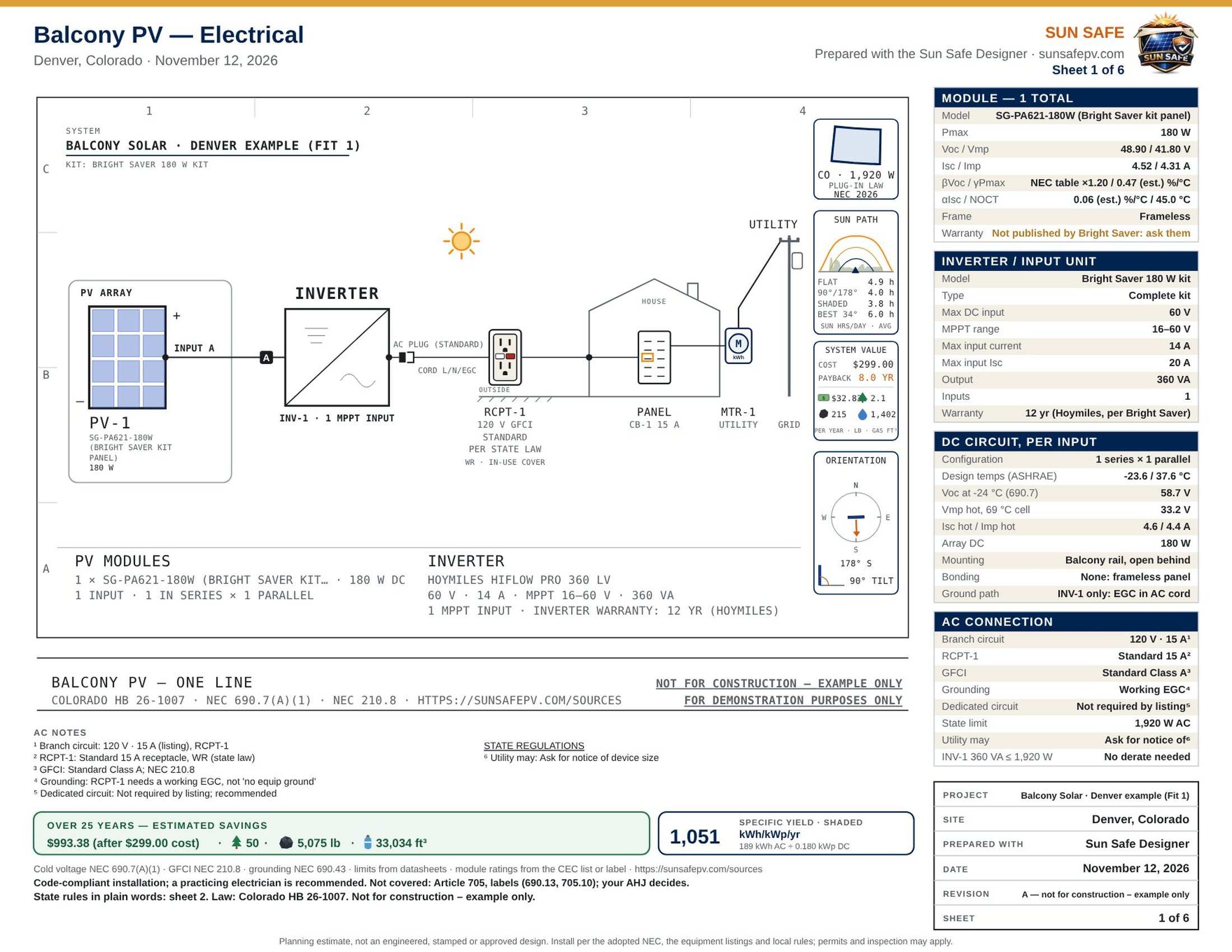
What each part of the drawing means
- PV ARRAY, the panel: one 180 W module (SG-PA621-180W) from the Bright Saver kit, drawn like the real panel. + marks the side whose wire runs to the inverter.
- INPUT A: the DC wire from the panel's + side into the inverter's one MPPT input (the part that tracks the panel's best operating point).
- INVERTER (INV-1): Hoymiles HiFlow Pro 360 LV. Turns the panel's DC into 120 V household AC. It is the only electronics in the kit.
- AC plug and cord: a standard 3-prong plug on a 15 ft cord. The third wire (EGC) is the safety ground.
- RCPT-1, the outlet: the balcony's existing 120 V outdoor GFCI outlet with an in-use cover. No rewiring.
- House and main panel, breaker CB-1 (15 A): the household circuit the outlet is on. The solar adds to what the circuit can carry, so the circuit size matters.
- MTR-1, the utility meter: in Colorado the utility may ask to be told about the device; no new meter is needed.
- Utility service: the power company's line. When the panel makes more than the home is using, the extra flows back out this way.
- State limit: Colorado HB 26-1007 allows plug-in solar up to 1,920 W without utility approval. At 391 W or less (this kit is 360 VA), no rewiring is needed.
- Sun path and sun hours: flat ground gets 4.9 sun hours a day here; this vertical, south-facing panel 4.0 with open sky, 3.8 after the neighbouring buildings' shade.
- System value: the $299.00 kit pays back in about 8.0 years at $0.183/kWh with prices rising 4.1% a year, saving about $32.83 in the first year. Icons, per year: 2.1 trees (seedlings grown 10 years to absorb the same CO₂, EPA), 215 lb of coal or 1,402 ft³ of gas not burned (EIA). Coal and gas are alternatives, not added together.
- Orientation: the panel faces 178° (2° east of due south) and stands at 90° tilt, upright on the balcony rail. That is how balcony solar is usually mounted.
- PV MODULES strip: how many panels, the model, total DC watts, and how they are wired (inputs, series, parallel).
- INVERTER strip: the model, its input limits (60 V, 14 A, MPPT 16–60 V), its 360 VA output, the number of MPPT inputs and the warranty.
- MODULE table: the panel's ratings from its label and the CEC list. Voc/Vmp are its open-circuit and working voltages; Isc/Imp its currents.
- INVERTER table: what the microinverter accepts from the panel (voltage, current) and what it puts out (360 VA).
- DC CIRCUIT table: the panel-to-inverter wiring checked against the code. Design temps are Denver's ASHRAE extremes (-23.6 °C / 37.6 °C); at the coldest the panel's voltage (58.7 V) stays under the inverter's 60 V limit.
- AC CONNECTION table: how it connects to the home. A shared 15 A circuit is allowed by the inverter's listing; a dedicated circuit is recommended. 360 VA is well under Colorado's 1,920 W limit.
- One-line title and code basis: Colorado HB 26-1007, NEC 690.7(A)(1) (cold-weather voltage) and NEC 210.8 (GFCI).
- Notes: the footnotes for the AC connection table and the state rules that apply.
- 25-year savings: about $993 after the $299 cost, with the trees, coal and gas the panel offsets over that time.
- Trees: not trees planted or cut down. It's the EPA's way of picturing CO₂: one tree seedling grown for 10 years absorbs about 0.060 t of CO₂. The panel avoids about 0.13 t a year (189 kWh × 0.000672 t per kWh), the same as 2.1 seedlings growing for 10 years; over 25 years, 50.
- Coal: the coal a power plant would burn to make the same electricity, 1.14 lb per kWh (EIA): 215 lb a year, 5,075 lb over 25 years.
- Gas: the same electricity from natural gas instead, 7.42 ft³ per kWh (EIA): 1,402 ft³ a year, 33,034 ft³ over 25 years. Coal and gas are two ways of picturing the same energy, so they aren't added together.
- Specific yield: 1,051 kWh per kW of panel a year, after shade. A quick way to compare sites: higher is sunnier.
- Title block: project, site, tool and date. Revision A, an example for demonstration, not for construction.
Plugged into the balcony’s existing outdoor GFCI outlet. At 391 W or less, Colorado’s law needs no rewiring and accepts a listed inverter; the inverter’s UL 3700 certificate (CSA 80310016) allows a shared 15 A circuit. A dedicated circuit is still recommended.
Live tally
How payback is figured
- Cost: $299.00 for the kit (panel and microinverter). The membership is left out.
- Recovered so far: measured kWh × $0.183/kWh = $1.82, which is 1.82 ÷ 299 = 0.61 % of the cost.
- Pace: $1.82 ÷ 15 days = $0.121 a day; $299 ÷ $0.121 = 2,462 days = 6.7 years. It updates with every batch of data.
- Why two numbers: an upright south-facing panel does best in fall and winter, when the sun is low, and less in summer. Pace from autumn days alone runs fast; the Designer’s full-year figure is the steadier guide until a full year is logged.
- Not included in the pace: electricity price changes, panel ageing and any rebates. The Designer’s 8.0 years does include them: prices rising 4.1% a year (Colorado’s last 5 years, U.S. EIA) and panels ageing 0.5% a year.
How the coal offset is figured
- Coal not burned: measured kWh × 1.14 lb, the coal a U.S. coal plant burns per kWh (EIA, 2022). 9.96 × 1.14 = 11.4 lb. Same factor as the Designer report.
- CO₂ avoided: measured kWh × 0.672 kg, the U.S. grid’s average marginal rate (EPA eGRID 2022). 9.96 × 0.672 = 6.7 kg.
- Sources: EIA: How much coal is used to generate a kWh? · EPA Greenhouse Gas Equivalencies, Calculations and References.
- Limits: national figures; Colorado’s grid mix differs.
Month by month
| Month | Days | Measured kWh | Estimated kWh | Measured vs estimate | Value |
|---|---|---|---|---|---|
| October 2026 | 4 | 2.65 | 2.62 | +1.3 % | $0.48 |
| November 2026 | 10 | 6.49 | 6.54 | −0.8 % | $1.19 |
Days compared against Golden’s sunlight. Nov 11 (0.83 kWh) is in the live tally but waits on Golden’s data before it joins this table.
- Measured: the microinverter’s own monitoring, daily totals.
- Estimated: each day’s sun hours at Golden × the panel’s Wh per sun hour from the Designer (October 125, November 137). Worked example on the Accuracy log.
- Value: measured kWh × the household’s electricity price, $0.182853/kWh (energy charge only). At 120–140 W peak the panel stays under the home’s background use, so it all counts as used at home.
- Why not the electric bill: about 16 kWh a month is smaller than normal month-to-month swings in use, and the bill gives one monthly total, not hourly readings.
What the Designer predicted
| Report | Year | October | November |
|---|---|---|---|
| Oct 28, 2026: original plan (old baseline) | 188 kWh | 19 kWh | 21 kWh |
| Nov 11, 2026: photo alignment refined from measured clear days (Fit 1) | 187.9 kWh | 18.6 kWh | 21.3 kWh |
| Nov 12, 2026: same Fit 1 alignment, skyline redrawn on the buildings in the photo (current) | 189 kWh | 19 kWh | 21 kWh |
Typical-year weather (NSRDB). Real months run above or below with the weather; the monthly table above corrects for that with the measured sunlight.
A clear day
How the photo is lined up with the curve
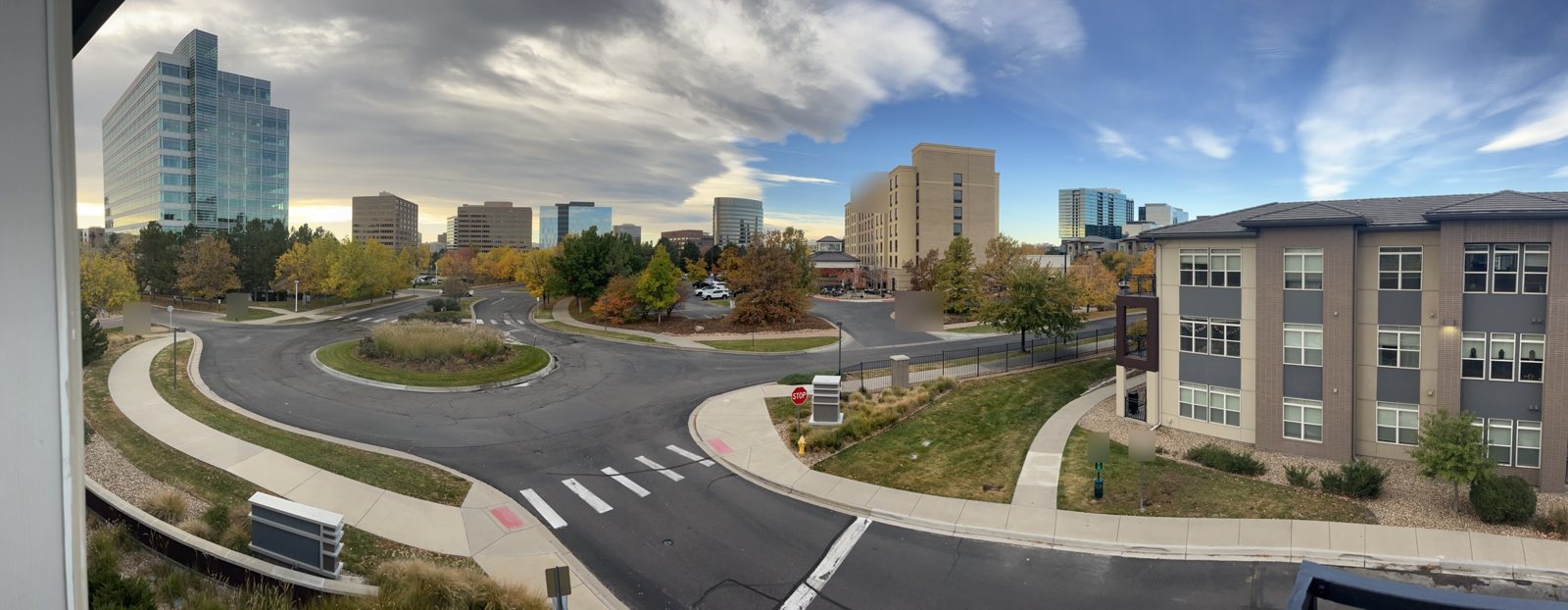
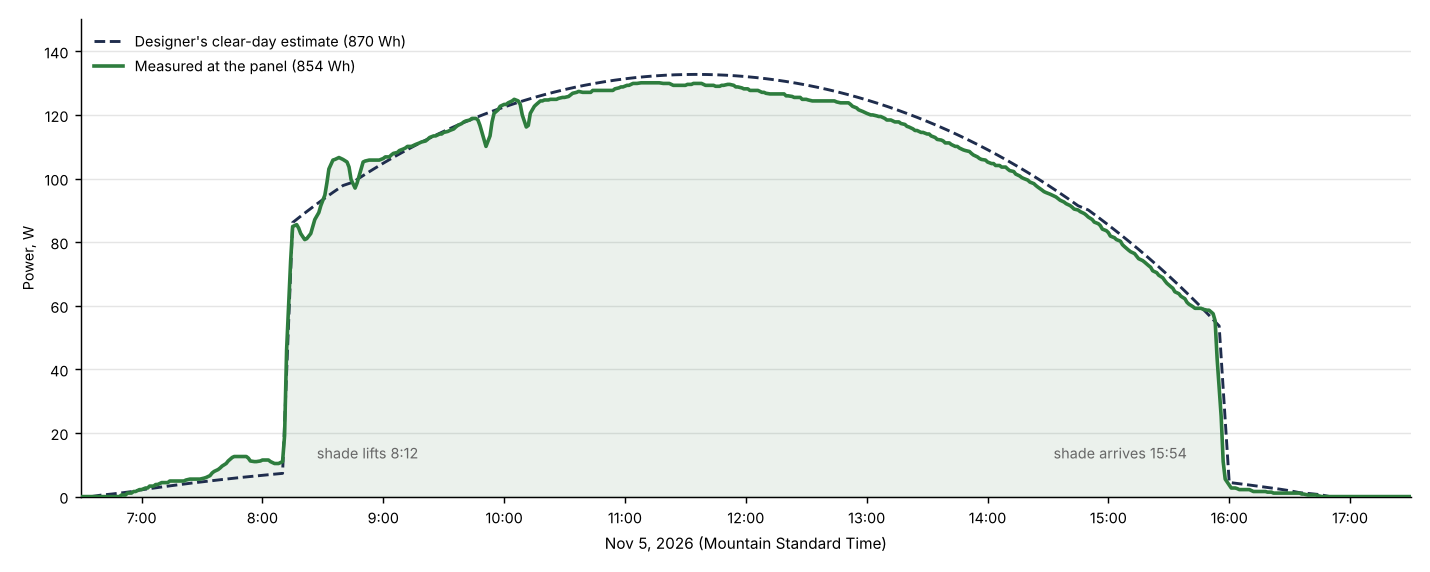
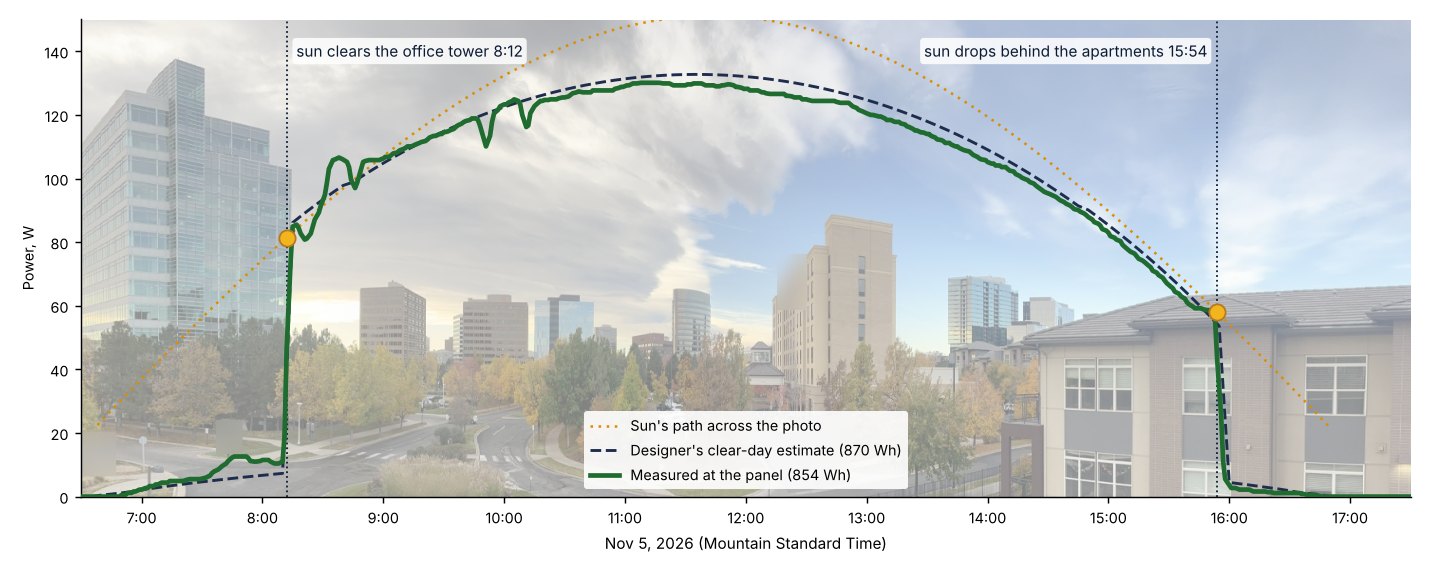
The photo is stretched so each moment on the time axis sits under the sun’s compass bearing at that minute, using the site alignment from Fit 1. The dotted gold line is the sun’s path across the photo. Until 8:12 the sun is behind the tower and the panel gets only sky light; once it clears the edge, power jumps to about 85 W. At 15:54 the sun meets the roof and power falls back to near zero. Nothing was nudged by hand: both edges line up from the geometry alone.
Sun Safe LLC · solar research and development, Rutland, Vermont · Home · Sources · Site version v326 · November 14, 2026